A Rewatch with One Detail in Mind
A rewatch with one visual detail in mind helps you track framing and other visual choices, compare scenes, and build a careful interpretation without overanalyzing.
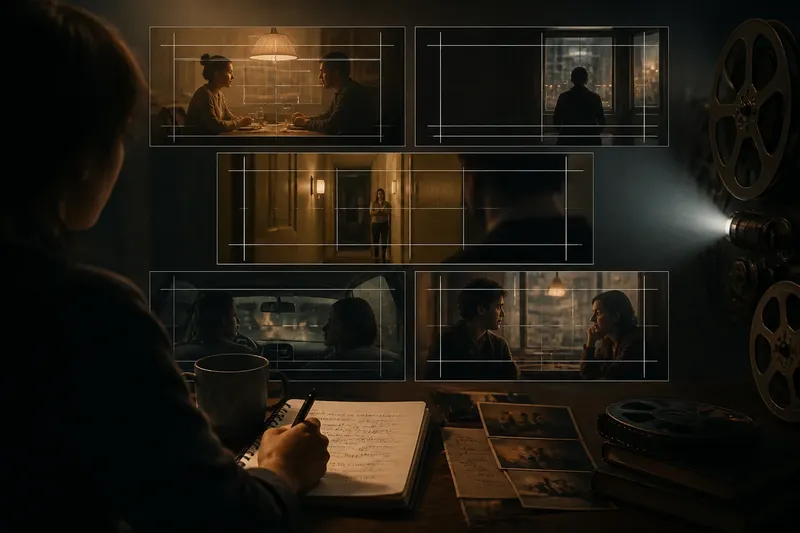
How do you rewatch a familiar film without simply following the same plot again? A rewatch with one visual detail in mind gives you a clear place to focus: choose a visible pattern, then notice how it changes from scene to scene. Framing, for instance, can show how a character’s place in the image shifts as a conversation changes.
The aim is not to solve the film or prove an interpretation. Notice a pattern, check it against particular moments, and consider what it contributes. Treat the chosen detail like a bookmark: it gives your attention somewhere to return while leaving room for the rest of the scene.
Choose one visual thread
Pick a feature you can identify while the film is moving. Framing is a useful starting point because you can track where people sit within the image, how much space surrounds them, and whether the camera keeps them together or separates them. Other workable threads include reflections, doorways, overhead views, foreground objects, or the distance between camera and subject.
Make the choice narrow enough to remember. “Notice the cinematography” is too broad: it asks you to attend to lighting, movement, color, lenses, and composition at once. “Notice when a character is framed alone during a two-person conversation” gives you a visible cue to watch for. You can decide what that cue might mean later.
Prefer a detail that seems likely to recur over a striking image you remember only once. If you are unsure, choose a simple visual question: Does the film place the person speaking in the center, at the edge, or outside the frame? The answer may vary by scene, and that variation is part of what you are watching for.
Set a manageable scope
Decide whether to follow the thread through the whole film or through a contained stretch, such as a family meal, a journey, or a sequence of conversations. A full-film rewatch may reveal changes across the story, while a smaller scope can make close attention easier. You do not need to make notes on every appearance.
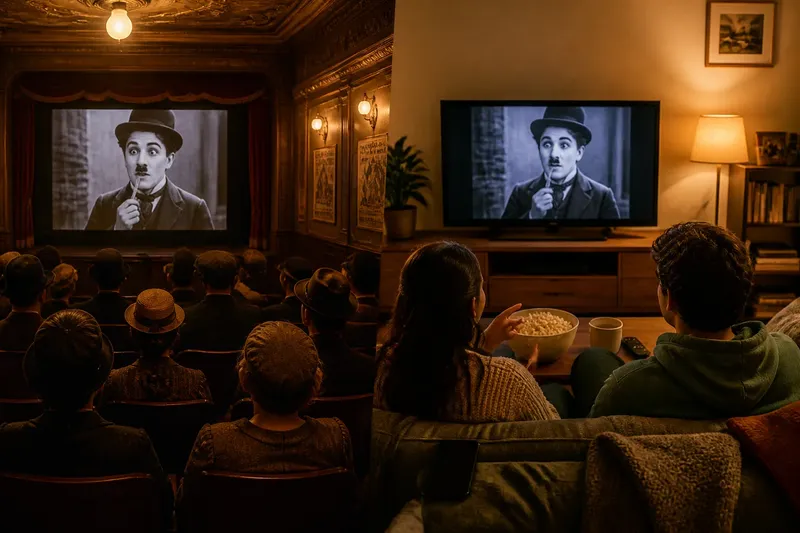
Choose a viewing setting that supports the detail you selected. A screen where you can distinguish the edges of a composition can help with framing; a quiet room can make it easier to keep your attention on the image. If you are watching on a phone or sharing the screen, adapt the question to what remains clear. The aim is attentive viewing, not ideal equipment.
Before you start, write one short prompt somewhere you can glance at between scenes: “When does the camera leave the listener out?” Keep it as a question. A prompt that already declares the film’s meaning can turn observation into a search for confirmation.
Watch for recurrence
On the first pass, notice when the selected detail appears and what is happening around it. If a character is pushed to the edge of the frame, note whether they are listening, withdrawing, being interrupted, or simply sharing space with another person. The surrounding circumstances keep a visual observation tied to the scene rather than floating free as a claim about the whole film.
Keep the record light. A few words are enough: “hallway—Mara at edge; doorway between them.” Use a paper notebook, a notes app, or a simple list with scene cues. Avoid pausing each time you see the detail unless you need to check a moment; constant interruption can make viewing feel like an inventory exercise.
Say you choose to track reflections in a film you know well. Imagine you notice a character first in a shop window during a conversation and later in a darkened train window after leaving someone behind. You jot down each scene and the character’s situation, then continue watching. The observable result is a small set of distinct appearances to compare, not a predetermined conclusion about what reflection means.
When a moment seems important, record what is visible before interpreting it. “Two people share the frame, but one is partly blocked by a lamp” is an observation; “the lamp represents their broken relationship” is an interpretation. You may later find the second thought useful, but keeping the two separate gives you room to revise it.
Compare changed moments
After the film, look across your notes for differences as well as repetition. Does the framing stay consistent when a character’s circumstances change? Does the visual choice appear only in certain settings or around a particular relationship? A recurring choice becomes more interesting when you can describe where it appears and where it does not.
Choose a small number of scenes to compare. If your thread is framing, consider who occupies the foreground, who is near the edge, whether the camera includes both speakers, and what remains between them. If your thread is reflections, compare the surface, the reflected person, and the surrounding action. These are prompts for looking, not boxes every scene must fill.
Replay a scene only when the first viewing left a specific uncertainty. You might want to check whether the camera moves toward a character before or after another person speaks. That is more useful than replaying a scene merely because it feels significant. If the detail remains unclear, leave it unresolved rather than forcing a reading.
Keep interpretation proportionate
Once you have observations, try a modest interpretation. Ask what the visual choice seems to do in those scenes: direct attention, create distance, make a character look exposed, or keep a relationship visibly balanced. Use language that fits the evidence in your notes. “The film often leaves the listener near the edge during these arguments” is more precise than “the film always makes the listener powerless.”
Look for a counterexample before settling on a pattern. A character may be centered during one tense exchange and pushed aside in another. That difference could complicate your first idea, or it may show that the framing responds to the scene rather than following a fixed rule. Either way, the exception belongs in your account.
Keep the story and other visual choices in view without switching your main task. Dialogue, performance, editing, and sound can all alter how a frame feels. You do not need to analyze each of them. If a camera holds on a listener after the speaker stops, for instance, that timing may affect your reading of the composition; record the connection briefly, then return to the detail you chose.
Questions for your rewatch
What counts as a recurring visual choice?
It is a visible decision that appears in more than one moment, such as keeping a character at the edge of the frame or showing a scene through glass. The appearances need not be identical; look for a similarity you can describe across scenes.
Should I pause to take notes?
Pause when a detail is hard to recall or when comparing the arrangement matters to your question. Otherwise, note a brief scene cue after the moment or once the film ends, so the record does not take over the viewing.
What if I notice several details?
Write extra observations in a separate margin, but keep the main prompt unchanged for this rewatch. You can choose a different thread on another viewing; the purpose here is to see what one question reveals when you stay with it.
How do I know when to stop?
Stop when you can describe the recurring choice, point to contrasting moments, and state a cautious interpretation that allows exceptions. More notes are not automatically more useful if they repeat the same observation without changing your understanding.
Leave a useful record
Finish with a short note that separates three things: the visual choice you tracked, the scenes that best show its variation, and the interpretation you currently find plausible. Add one question you would carry into another viewing. This keeps the result useful without turning it into a verdict on the entire film.
For a rewatch with one visual detail in mind, a good record is specific enough to guide your next choice. You might decide to watch another film by the same director for similar framing, or revisit a scene because an apparent exception remains puzzling. Either decision follows from what you noticed, not from a requirement to complete an analysis.
Close your notes while the scenes are still easy to picture, but leave the interpretation open. A visual pattern can change meaning when you notice a new context. You do not need to notice everything at once to see something more clearly.