Subtitles On or Off? Choose by What You Want to Notice
Subtitles on or off depends on what you want to notice. Compare reading, original voices, and dialogue clarity to choose a viewing mode that suits the scene.
Should you watch with subtitles on or off? For subtitles on or off, the useful question is what you want to notice: an actor’s voice, the details of the image, or the story itself. Subtitles and dubbing offer different routes into a film or show, and the better choice can change with the language, the room, and your attention that evening.
Three viewing modes
With subtitles, you hear the original performances and read translated dialogue. The actor’s voice stays connected to the face, but your eyes move between the text and the image. This suits viewers who value vocal texture or prefer reading a brief line to hearing new voices fitted to familiar faces.
With dubbing, a new voice track replaces the original dialogue. Translation arrives through speech rather than on-screen text, leaving your eyes free to stay on the image. That can help when you are tired, sharing a screen with someone who dislikes reading, or trying to follow rapid action. You hear a performer’s choices, but not the original actor’s voice.
A third option is to watch without subtitles or dubbing, when the dialogue is already clear to you or you want to attend closely to other sounds. This can work well in a familiar language, but a quiet line, unfamiliar accent, or noisy room may make speech harder to follow. It suits a scene where the image or soundscape is the point, provided you do not mind missing a word.
Think of subtitles as a map printed on a window. They help you find the spoken meaning, but occupy part of the view. Dubbing removes that printed route while changing the voice that carries the story. Neither option gives you everything at once.
Reading and looking
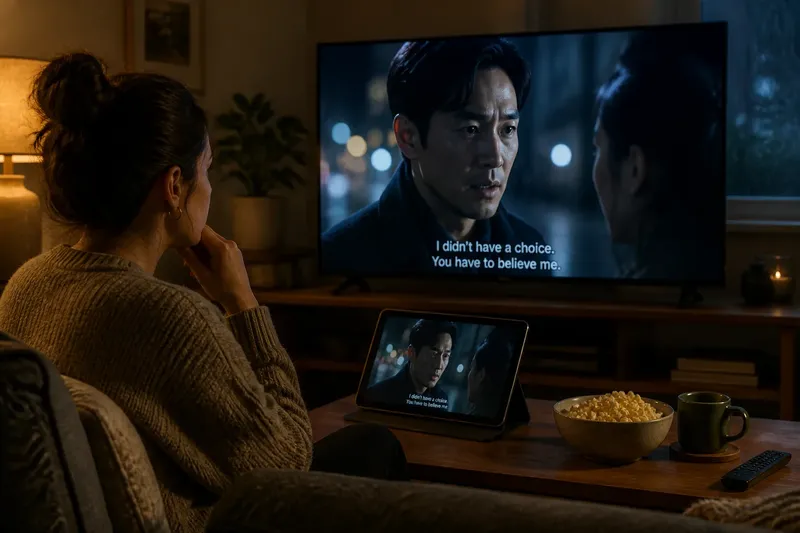
Subtitles ask for quick shifts of attention. You read a line, return to a face, and may glance back when the words arrive during a gesture or a revealing change in expression. With clear, well-timed text, this rhythm can feel natural. In a crowded frame, a rapid exchange, or a scene built around small visual clues, however, captions may claim the attention you wanted to give the image.
Line breaks, contrast, placement, and the amount of dialogue on screen can affect how easy text is to follow. If it covers a face or lands over important action, try changing its position or appearance in the player settings. If your television app offers no such controls, another device or version of the title may display captions more clearly.
Dubbing removes the need to read dialogue, which can help when you are watching from across the room or glancing away between scenes. Yet the replacement voice can draw attention for its own reasons. A line may sound more formal or more playful than the actor’s expression suggests, and timing may differ when spoken words are fitted to visible mouth movements.
Consider what the scene asks your eyes to do. A still conversation may leave room for captions; a chase, dance, or visually dense mystery may reward keeping your gaze on the frame. That is a preference about attention, not a rule that one format suits an entire genre.
The sound of performance
An actor’s voice carries more than dialogue. Breath, pitch, hesitation, accent, and the edge of a laugh can give a line its character. Subtitles retain that performance, even when you cannot understand the spoken language. They let you hear whether a reply arrives softly or sharply while the translation gives you its broad meaning.
Translations are interpretations, not exact duplicates. A subtitle may condense a phrase so it can be read in time, while a dubbed line may choose words that fit a mouth movement or the rhythm of a scene. If you switch between versions, you may notice differences in humor, formality, or a character’s apparent warmth. Those differences reflect the limits and choices of adaptation; they do not automatically make one version inaccurate.
Dubbing can still offer a vivid performance. A voice actor brings timing, emphasis, and feeling to a role, and the new track may make the story accessible to a viewer who would otherwise miss its dialogue. The question is whether you want the original actor’s voice specifically, or whether spoken translation is your easiest route into the scene.
Sound mixing matters, too. Music or effects may sit close to dialogue, and some streaming versions offer separate audio description or language tracks. If speech is difficult to distinguish, subtitles or captions may clarify it; if the original voices are hard to hear, a dubbed track may be easier to follow. Check which language and caption options the title actually offers.
Questions for this viewing?
When should I choose subtitles?
Choose subtitles when the original voices matter to you or you can read comfortably without losing the scene’s visual thread. They also suit translated dialogue when you prefer not to replace the original performance.
When is dubbing a better fit?
Choose dubbing when reading competes with the image, when someone watching with you prefers spoken translation, or when the original dialogue is difficult to hear. It can also help during casual viewing if you expect to look away from the screen.
Can I change modes midstream?
Yes. Switching at a scene break can help you judge which version feels clearer and more emotionally convincing without interrupting dialogue. If a change disrupts your concentration, settle on one mode for the rest of the scene.
What if neither option feels right?
Try a different caption style, audio track, or viewing device if available. If you do not need every line, watching without text may feel comfortable; if understanding the dialogue matters, choose the version that keeps speech clearest for you.
A scene comparison
Say you want to watch a foreign-language mystery on a tablet in a bright kitchen while someone else is talking nearby. You start with subtitles because you want the original actors’ voices. A clue appears in a character’s quick glance just as a dense line fills the bottom of the screen, so you pause at the next quiet scene and switch to dubbing. Now you can watch the performers more closely, but one replacement voice feels less natural to you. You return to subtitles for the next conversation, accepting the extra reading to keep the original voices. The choice reveals a tradeoff for this viewing: captions preserve the vocal performance, while dubbing makes it easier to watch the image.
For a useful comparison, choose a brief scene with both dialogue and visible acting, then leave each setting alone long enough to settle into it. Notice whether you follow the exchange, catch expressions, and stay connected to the characters. An unfamiliar voice can feel distracting at first, just as captions can take a moment to become part of your viewing rhythm.
Choices by context
Your preferred mode can change with the room and the day. A quiet evening with a carefully staged drama may invite subtitles and close listening. A shared comedy watched while dinner is being cleared may work better dubbed, so no one has to track every line with their eyes. For a familiar show, leaving text off might make room for background details you already know how to notice.
Accessibility needs deserve a separate check. Subtitles generally translate dialogue, while captions may also identify speakers and relevant sounds; terms and options vary by service. If hearing, vision, reading, or language needs affect your choice, explore caption appearance, audio tracks, screen size, and accessibility settings. For specific accommodation needs, consult the service’s accessibility information or a qualified professional when appropriate.
There is no need to defend a preference as a general rule. If the original voice is your way into a story, subtitles may be worth the extra eye movement. If reading breaks your connection to the picture, dubbing may serve you better. Start with what you want to notice, and treat subtitles on or off as a choice for each title, not a setting you must keep forever.